

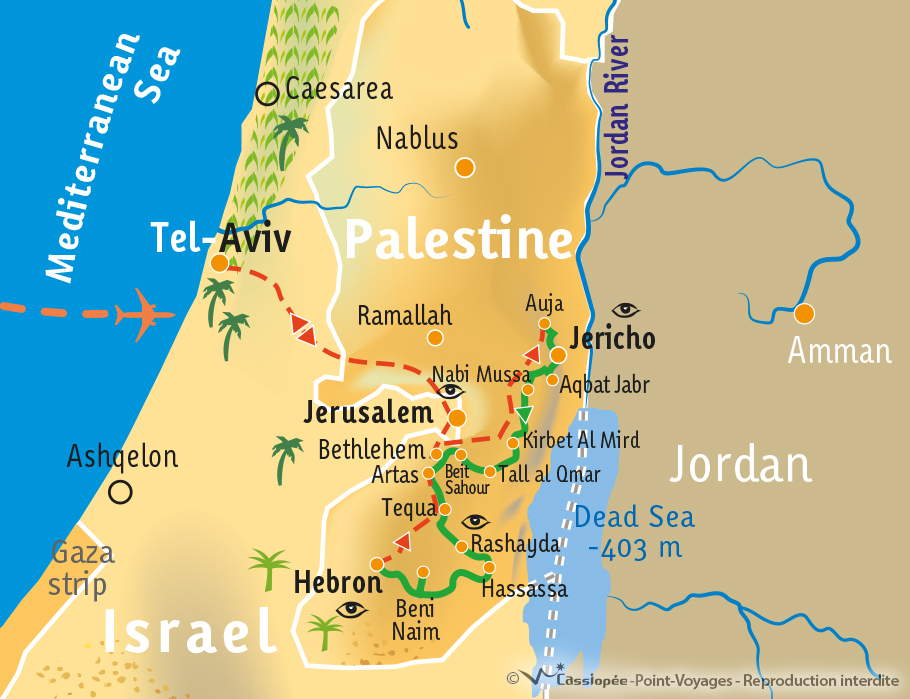
This tour is designed as a hiking route of the Abraham Path. You will pass by bicycle through roads, fertile valleys, oasis and rocky canyons. Unforgettable journey and wander through the country’s hidden treasures, explore the heights and depths of its wonder and encounter the local hospitality, rich history and heritage. This path named Abraham Trail regarding to Prophet Abraham; who is recognized as a prophet and messenger of God. Abraham plays a prominent role as an example of faith in Judaism, Christianity, and Islam.
Day 1: Tel-Aviv - Jerusalem
Arrival at Tel-Aviv airport. Welcome and reception by a member of our team transfer to Jerusalem. Dinner and overnight at hotel in Jerusalem
Day 2: Jerusalem
After breakfast, visit the Old City of Jerusalem. In the Old City you will encounter oriental charm and be plunged into the souk’s colourful alleys, which take you to the meeting places of the three major monotheistic religions: Christianity, Judaism, and Islam. Visit the Via Dolorosa, believed to be the path that Jesus walked on the way to His crucifixion, the Holy Sepulchre which houses both the place of Calvary and the tomb of Christ. Passing through the Christian, Jewish, Muslim and Armenian districts, you can contemplate the vestiges and the religious and architectural imprints left by the different peoples who lived there. Continue the visit by taking the ancient Roman road, the Cardo, located in the heart of the old city, up to Mount Sion where you will discover the Dormition Abbey, the cave of the Last Supper and the tomb of King David. Visit the Church of Saint Peter in Gallicante, also known as the “Rooster Church”. The day ends walking in the Armenian quarter to the Jaffa gate. Dinner and overnight at the hotel in Jerusalem
Day 3: Jerusalem – Bethlehem
After breakfast, visit the Wailing Wall, the holy place of Judaism, then the esplanade of the Haram Al-Sharif; the third holiest religious site in Islam. It contains the Al-Aqsa Mosque and the Dome of the Rock, the gem emblematic of the Holy Land, with its golden dome shining brilliantly on the Jerusalem skyline. Then visit the Mount of Olives, with its 827m altitude, it offers a wonderful panoramic view of the old town and has places of great importance for the three monotheistic religions. Visit the chapel of Dominus Flevit, recalls the Gospel incident in which Jesus wept over the future fate of Jerusalem. Descent from the Mount to the Garden of Olive Trees with the Church of All Nations, Gethsemane, the place where Jesus would have prayed before his arrest. Departure for Bethlehem located 10 km from Jerusalem to discover the Basilica of the Nativity, one of the oldest churches in the world, built above the cave where Jesus was born. Visit the Milk Grotto and the historic city center, walk through the old quarters and market. Dinner and accommodation at the hotel in Bethlehem.
Day 4: Bethlehem – Auja – Jericho – Dead Sea – Aqabat Jaber
On the first day of the cycle tour, transfer to Auja village to see the oldest traditional water channels. The historical roots dating back to the reign of the Roman Emperor Herod, after Auja, continue cycling to Jericho, known as one of the oldest cities of the Levant dating from the eighth millennium BCE. Jericho is also the lowest city in the world, at 250m below the Sea level. Visit Deir Quruntel, better known as the Mount of Temptation. Continue cycling to the Dead Sea, the lowest point on the Earth, over 400m below Sea Level. You will experience the indescribable feeling of floating on the Dead Sea. Journey to Aqabat Jaber refugee camp to the Aqabat Jaber Guesthouse and meet with the Aqbat Jaber Women's Association, a nonprofit organization of the refugee camp, who will introduce themselves and their production of local products. Dinner and overnight in the camp. Cycling distance: Approximately 45 km. 6/7h
Day 5: Jericho –Wadi Qelt – Nabi Mousa –Sea Level
After the breakfast start cycling from Aqabat Jaber Camp near Jericho, through the picturesque Wadi Qelt to visit the ruins of King Herod’s Winter Palace and then see the clinging to the side of the rocky canyon Deir al-Qelt (St. George’s Monastery). The view transports visitors to the 4th century when the earliest desert-dwelling monks sought lives of faithful seclusion. The wadi offers a unique variety of flora and fauna. The road becomes easier as it leaves the monastery and heads towards the Roman aqueduct – another spectacular landmark located along that section of Masar Ibrahim. The trail passes through the remote lands and the wilderness of the Jordan Valley, to lead to the historic road from Jericho to Jerusalem. Continue to the desert sanctuary of Nabi Musa, dating to the 13th century, that is remembered as the final resting place of the prophet Moses in the Islamic tradition. The site consists of the tomb and a mosque and a spacious compound built around them. Continue to the Bedouin’s camp located exactly at the sea level, you will learn more about the Bedouins, their culture and life style, dinner and overnight. Cycling Distance: Approximately 25 km.
Day 6: Kirbet El Mird –Mar Saba – Tal Al Qamar
Start cycling from sea level to Kirbet El Mirdn, the ruins of a Byzantine monastery that Is 5 km in the north-East of Mar Saba Monastery located on the top of a mountain that includes several hermit caves, then continue to Mar Saba. Mar Saba is among the most ancient and wondrous desert monasteries in the Holy Land. Women have not been allowed into Mar Saba for fifteen centuries, but may admire the monastery from afar - over its exterior walls. Continue cycling through the canyons up to Tal al Qmar, where the path was mostly mountains and canyons. There in the middle of the wilderness can be found a guesthouse with a Bedouin-themed lounge where hikes can have a homemade meal, relax and overnight. Cycling Distance: Approximately 30 km. 5/6h
Day 7: Tal Al Qamar –Beit Sahour – Battir – Bethlehem
Start cycling from Tal Al Qamar to Beit Sahour, visit the ruins of the Byzantine monastery of the Shepherds' Field, where the angels announced the birth of Jesus. Continue cycling to Bethlehem, across Beit Jala to Battir village, situated in a picturesque setting to say the least, in the middle of millenary olive groves. We go up towards Bethlehem via a narrow path going up a canyon. Our tour continues to the Israeli-built Separation Wall, also called the Wall of Shame and Apartheid Wall by the Palestinians. Visit Aida refugee camp. Dinner and overnight in the hotel in Bethlehem. Cycling distance: Approximately 40 km. 6/7h.
Day 8: Bethlehem – Artas –Wadi al-Jihar –Al-Rashayda
Start cycling from Bethlehem and visit the old pools of king Solomon in Artas village. Continue into the spectacular Wadi Jihar, a deep limestone canyon that winds down into the desert. Arrival at Bedouin camping village of Al-Rashayda, which is located in the desert region between Bethlehem and the Dead Sea. Continue to the beautiful sunset view of the Dead Sea. Back to evening and night in the Bedouin camp. Cycling distance: Approximately 50 km. 7/8h.
Day 9: Al-Rashayda - Beni Naïm - Hebron & Bethlehem
Start cycling from Al-Rashayda, heading towards Beni Na’im, a tranquil village famous for the grape groves surrounding the area. Continue to Hebron, a city had built before 4000 years by the Canaanites, place of the Tomb of the Patriarchs, which contains the tomb of Abraham and a mosque, part of which has now become a synagogue. Tour the Old City and learn about the unique and challenging situation, experienced daily by the inhabitants of Hebron, neighborhoods and streets divided by the settlers and protected by an extremely large garrison of Israeli soldiers. The old city market offers visitors many surprises including the famous ancient glass factories and colorful eastern ceramic workshops. Transfer to Bethlehem, dinner and overnight. Cycling Distance: Approximately 35 km. 6/7h
Day 10: Bethlehem - Tel Aviv
After breakfast, transfer to the airport in Tel Aviv for the return flight.
| 1- Guaranteed Departures: From 5 Participant 2- Budget:
Our quoted price for any tour does not include the following:
Travel Agencies & Independent Groups: Travel agencies & tour operators may contact us for your unique website access code and special conditions. Independent groups may be offered discounts on posted rates depending on their numbers, tour itineraries and requested services. 3- Arrival at Ben Gurion International Airport: Customs: In most cases with both arrivals and departures, tour participants will proceed through customs and security inspections as they do in any other international airport without significant delay. On occasion, however, Ben Gurion Airport security may select program participants for questioning. This is a common occurrence at Ben Gurion security and is no cause for alarm. For more information please click here. 4- Cancellation Fees: Cancellation fees will apply as follows:
The above conditions do not apply in case of natural disaster, pandemic, and the outbreak of war. For geopolitical or logistical reasons, the tour operator has the right to cancel a departure or propose alternative date. In this case, full amount paid to the trip organizer will be refunded. 5- Visa & Passport: 6- Transport and transfer: 7- Accommodation: Food: Breakfasts will always be given at the various accommodation (hotel, guesthouse, Bedouin camps, homestays). They are generally composed of local bread and preparation. During the days of trekking, the midday meals will be in the form of various picnics. We will stop near the best natural spots, offering shade and beautiful panoramas. The local team will prepare something to refresh you and treat you, based on regional specialties, easy to transport. Our hosts at the guesthouses, Bedouin camps and the families who welcome us will cook us some lunches and snacks, made with fresh, traditional products. You will taste among other things their homemade stuffed breads and many other delicious local foodstuffs. While visiting different cities, you can have lunch in local restaurants and snacks, taste specialties such as hummous, tabbouleh, falafel, shawarma etc. 8- Recommendations - level: Bikes and equipment: Equipment: Clothing: 9- Flight and insurance: 10- Tours – Guide – Tips: Follow the guide: Our local guides are professionals and knowledgeable of the culture and history of the land that you are touring. Generally, a single guide accompanies the group for the duration of the tour. However, for logistical reasons, unavailability and due to the local situation, two or three guides may be used during your program. Our local guides are chosen for their knowledge base, professionalism, ethical standards and willingness to communicate with their tour groups and are always ready to answer questions! Tips: We recommend a tip of $6 -10 per participant per day, to be shared between the guide 60% and the driver 40%. Tips are not included in your program costing, and while not compulsory, we do ask that you strongly consider setting aside the suggested amount 11- Languages - Currency: Languages: The official language in Palestine is Arabic, while the official and language of Israel is Hebrew. The unofficial second language of the Holy Land is English, with French and Russian spoken in much of Israel as well. 12- Health: 13- Weather: 14- Time - Customs: Clothing restrictions: 15- Child conditions: 16- Telecommunications & electricity: Electricity: The electric current is generally 220V, utilizing European-regional sockets (round plugs). An adapter is required for UK-regional appliances. Abraham Path: electricity is available in all accommodations |
Review Cycling The Abraham Path
Through History Culture
and Incredible Landscapes.